The Cost of Waiting: What the Research Says About Delays in Workers' Comp
Across multiple independent studies, one of the biggest levers tied to claim cost and duration is how quickly an injured worker is reported, seen, and treated. Here's what the research says about the cost of delay.

- Injured workers who received medical care within the first one to three days after an injury had an expected disability duration of about 44 days, compared to 53 days for a one-to-two week wait, and 64-67 days for waits of two weeks or longer.
- Claims reported 29 or more days after the injury led to 33% increase in lost time, 52% increase in claim cost, and 152% in litigation.
- Every process improvement that shortens the time between injury and appropriate care correlates with shorter disability duration and lower claim costs.
- Every claim follows a different path, but one thing stays constant: when someone needs treatment, delays cost the patient as much as they cost the claim.
We’ve all heard the phrase “time is money” used as a figure of speech. In workers' compensation, the research bears out the literal truth in those words — but money is only half of it.
At the center of every claim is a person: someone in pain, waiting to find out what's wrong and how to get better, wondering when they'll be able to return to work and to their life. Costs can be recovered, reserves adjusted, claims reopened, but time can't be recouped. It's the one thing that can't be bought back, banked, or paid for after the fact. Across multiple independent studies, one of the biggest levers tied to how long and expensive a claim becomes, and how much an injured worker has to bear along the way, is how quickly they get reported, seen, and treated.
Delays in reporting an injury are costly
A large, peer-reviewed study of workers' compensation claims published in the Journal of Occupational and Environmental Medicine tracked over 64,000 occupational low back injury claims and found that shorter lag times in reporting the injury, receiving medical care, and starting work disability were consistently associated with shorter overall disability duration.¹ Workers who reported their injury within two weeks had, on average, more than a two-week shorter predicted disability duration than those who waited 30 days or longer.¹
Delays in receiving treatment are costly too — and the effect compounds
The same study found that workers who received medical care within the first one to three days after injury had an expected disability duration of roughly 44 days. That number climbed steadily the longer treatment was delayed: about 53 days for a one-to-two-week wait, and 64 to 67 days for waits of two weeks or longer.¹ Roughly 10% of claimants in the study didn't receive any medical treatment within the first two weeks after injury, and for that group, predicted disability ran more than two weeks longer than for workers treated within the first three days.
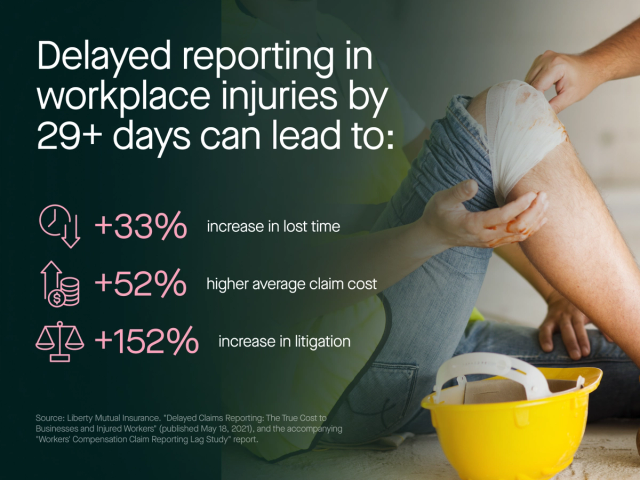
This isn't an isolated finding. Liberty Mutual's Workers' Compensation Claim Reporting Lag Study, an analysis of the insurer's own workers' compensation book of business, developed using standard actuarial reserving methods, found that, compared with claims reported within 0 to 3 days of injury, claims reported 29 or more days after injury were 33% more likely to become an indemnity claim, 152% more likely to be litigated, and carried an average claim cost 52% higher.² Liberty Mutual's findings echo earlier research from the National Council on Compensation Insurance (NCCI), whose January 2016 study, "The Relationship Between Accident Report Lag and Claims Cost in Workers' Compensation," identified the same basic pattern: the longer it takes to report an injury, the more a claim tends to cost.³
Access matters as much as timing
In March 2026, the Workers Compensation Research Institute (WCRI), an independent, nonprofit research organization whose data underpins much of the industry's understanding of claim costs, released a 34-state study on the impact of medical provider networks on claim outcomes. It found that injured workers treated in-network received care sooner, incurred lower medical costs, and spent less time on temporary disability than those treated out-of-network. In other words, the systems and relationships that get a worker to appropriate care faster don't just improve the experience, they show up directly in the cost and duration of the claim.⁴
Why this keeps happening
None of this is really about any single decision-maker moving slowly. Every claim is different, and no two injured workers travel quite the same path to recovery. They can branch through any number of routes from initial injury to determining the right course of treatment, and often loop back through several of those steps again. But one thing stays consistent: when someone needs treatment, delay is costly, not just to the claim, but to the patient and their wellbeing. Diagnostic imaging tends to be the fork in the road: get the scan completed, then interpreted quickly and accurately, and the claim moves toward the right treatment for the person who needs it; delay it or get it wrong, and everything downstream stalls, for the claim and for the worker still waiting on an answer. Research on "lag time" treats each link in that chain as a separate, measurable variable, and the data shows that friction anywhere along the journey shows up later as real dollars, in more disability days, higher indemnity, higher medical spend, and as real time lost from someone's life. For claims professionals this reframes "speed" from a soft metric of customer experience into both a core cost-containment lever and a matter of care for the injured worker.
The takeaway for claims teams
Every process improvement that shortens the time between injury and appropriate care — faster reporting, faster authorization, faster scheduling for diagnostics and specialist visits — is backed by a body of independent research showing it correlates with shorter disability duration and lower claim costs. That's a strong argument for auditing where the friction actually lives in your own claim journey, rather than assuming that adjuster attention alone can offset a slow back-end process. Because behind every claim number is a person waiting to get better, and for them, time isn't a line item. It's the thing they can't get back.
Reach out to a member of our workers’ comp team today to see how Scan.com can help reduce friction in your claim journey, lower costs, and improve outcomes.
Footnotes
Want research tailored to your book of business?
Send us a de-identified claims extract and we'll model your imaging spend — no commitment required.